
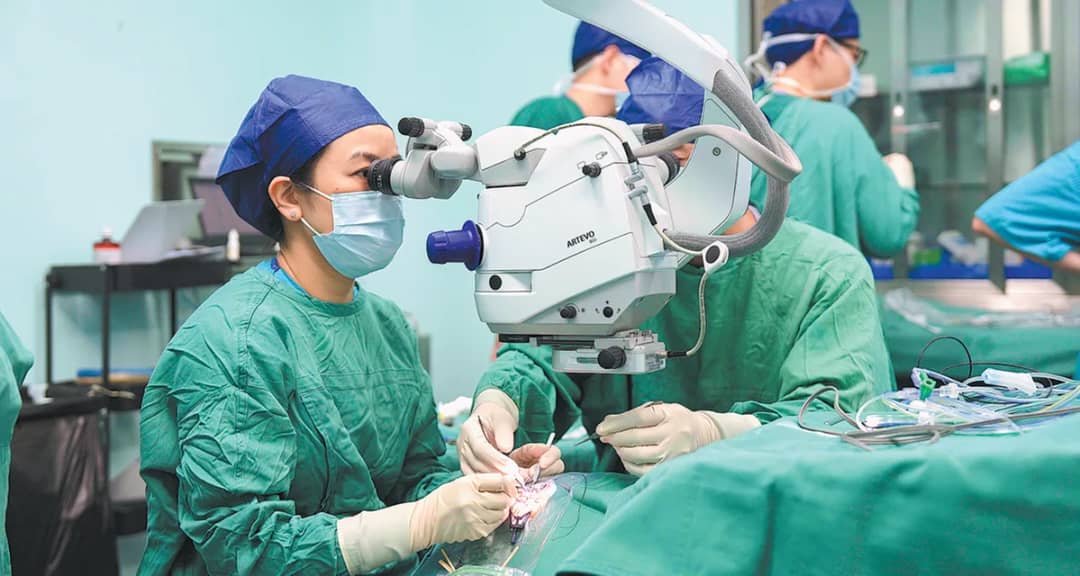

A Chinese medical team has helped a blind man regain limited visual perception after more than 30 years of blindness through an eye implant that enables him to recognise letters and numbers, pick up objects and navigate around obstacles.
The procedure was performed in July at Renmin Hospital of Wuhan University in Hubei Province, China, on a patient identified only by his surname, Qiu, according to China Daily.
The technology combines a surgically implanted chip with specially designed glasses fitted with cameras. The cameras capture images of the patient’s surroundings and convert them into electrical signals, which are transmitted wirelessly to the chip implanted in the sclera, the outer white layer of the eyeball.
The implant stimulates nearby nerve pathways, sending signals to the brain’s visual cortex, where they are interpreted as visual patterns.
The hospital’s vice-president, Xiao Xuan, said Qiu began rehabilitation training after resting for a month following the operation, with his progress exceeding initial expectations.
Xiao explained that the patient could perceive spots of light immediately after putting on the glasses, adding that repeated training sessions helped him gradually interpret the signals.
According to her, Qiu was able to recognise and write numbers, letters and Chinese characters, pick up objects accurately and walk independently along visual markers within three weeks of training.
However, she said the patient would require prolonged and systematic rehabilitation to read texts accurately and identify objects with finer details.
Xiao likened the process to an infant learning to understand the world, explaining that patients must gradually learn to associate the electrical signals they perceive with objects and their surroundings.
The chip is smaller than half a fingernail and does not penetrate the eyeball, according to the report. The design also eliminates the need for wires connecting the inside and outside of the eye or external magnetic attachments.
Xiao said implanting the device in the sclera rather than directly against the retina could reduce tissue damage compared with some other surgical approaches.
She said the technology could potentially benefit people with seven types of blindness associated with nerve damage, including retinitis pigmentosa, advanced age-related macular degeneration, advanced glaucoma and diabetic retinopathy.
However, she noted that people whose eyeballs and optic nerves had been completely destroyed would not qualify for the treatment.
Despite the progress, the technology does not yet reproduce natural vision. While normal sight allows people to perceive colours, depth and three-dimensional objects, the implant generates light spots known as phosphenes through electrical stimulation, creating pixel-like visual patterns.
Xiao identified the reproduction of colour vision and the accurate mapping of signals between retinal nerves, the optic nerve and the brain’s visual cortex as major challenges researchers still needed to address.
The long-term objective, she said, was to improve patients’ independence by helping them travel alone, avoid obstacles and identify banknotes.
Qiu, who works as a blind massage therapist, said his visual impairment had made travelling alone dangerous. He recalled nearly being hit by an electric motorbike, an experience that made him reluctant to go out without assistance.
He expressed hope that the technology would make everyday activities easier as he gradually regained visual perception.
The report added that Qiu experienced mild eye irritation during the initial electrical stimulation and adjustment of the device but adapted to the implant shortly afterwards.